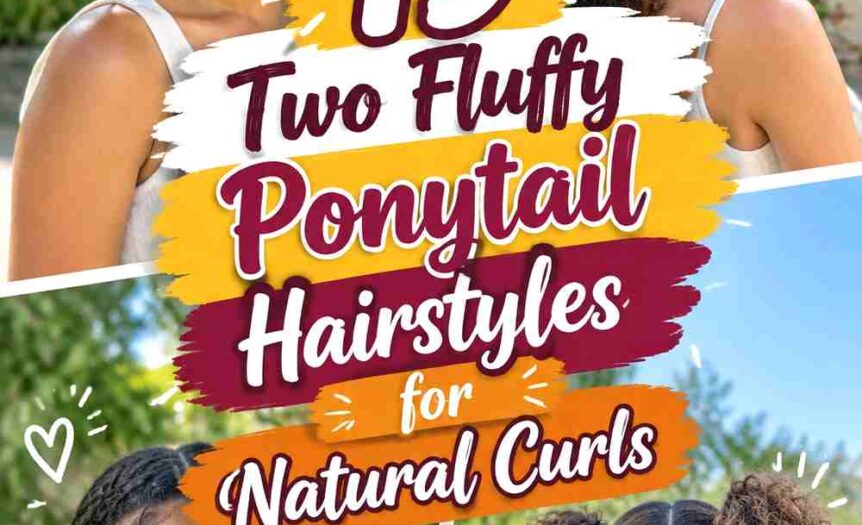
#Fluffy #Ponytail #Hairstyles #Natural #Curls
Fluffy twin ponytails let natural curls keep their volume, shape, and movement while creating a playful two-ponytail silhouette with plenty of styling variety.
Two fluffy ponytails work especially well with natural curls because the texture already provides dimension without needing every strand to look uniform. Changing the ponytail height, parting, root finish, and amount of face framing can make the same basic two-ponytail idea feel polished, casual, bold, or soft.
These 19 variations are designed around visible curl texture rather than smoothing the hair into an artificial shape. Keep the bases secure but comfortable, preserve natural density through both ponytails, and let the ends retain realistic differences in curl size and direction. The best result should make the curls look full and touchable while keeping the two sides visually balanced.
Quick List
- High Twin Fluffy Ponytail Hairstyle
- Low Twin Fluffy Ponytail Hairstyle
- Mid Height Curly Twin Ponytail Hairstyle
- Center Part Fluffy Ponytail Pair Hairstyle
- Side Part Twin Curly Ponytail Hairstyle
- Half Up Twin Fluffy Ponytail Hairstyle
- Wrapped Base Twin Fluffy Ponytail Hairstyle
- Face Framing Twin Fluffy Ponytail Hairstyle
- Crown Lift Twin Curly Ponytail Hairstyle
- Stretched Root Fluffy Twin Ponytail Hairstyle
- Mini High Twin Fluffy Ponytail Hairstyle
- Low Puff Twin Ponytail Hairstyle
- Asymmetrical Twin Fluffy Ponytail Hairstyle
- Tapered Part Twin Curly Ponytail Hairstyle
- Loose Front Twin Fluffy Ponytail Hairstyle
- Side Tucked Twin Ponytail Hairstyle
- Long Natural Curl Twin Ponytail Hairstyle
- Voluminous Rounded Twin Ponytail Hairstyle
- Soft Defined Twin Fluffy Ponytail Hairstyle
1. High Twin Fluffy Ponytail Hairstyle

High twin ponytails put natural curl volume near the crown, creating a lifted silhouette with plenty of movement around the upper sides of the head. A center part keeps the bases balanced, while the ponytails can expand naturally rather than being brushed into identical shapes. Medium to long curls usually provide enough length for each side to fall outward and downward without losing the high placement. Leave a few fine curls around the hairline if you want a softer front, or keep the sides more controlled for a cleaner finish. The key is securing each base firmly enough to hold while letting the ponytail lengths remain fluffy, separated, and true to their natural curl pattern.
Styling Notes
Position both bases before adjusting the ponytail volume. Once secure, lift and separate the curls gently with your fingers instead of brushing through the finished texture.
2. Low Twin Fluffy Ponytail Hairstyle

Low twin fluffy ponytails create a softer shape by placing both bases close to the nape or just behind the ears. The lower position allows natural curls to fall over the shoulders while reducing the amount of lift and tension around the crown. A center or slightly off-center part can work, depending on how symmetrical you want the front to look. This style is especially flattering on medium to long curls because the ponytails retain enough length to stay visible from the front. Let the outer curls expand naturally instead of compressing them into tight bundles. Fine face-framing pieces can remain loose around the temples to reinforce the relaxed, wearable finish.
Best For
Choose this version when you want two ponytails with a softer profile or prefer less weight concentrated high on the scalp.
3. Mid Height Curly Twin Ponytail Hairstyle

Mid-height twin ponytails sit between playful high puffs and understated low ponytails, making them one of the most versatile options for natural curls. Position the bases roughly around ear level or slightly above, then allow the curl volume to spread outward naturally. The result keeps the ponytails visible from the front without creating dramatic crown height. A clean center part offers balance, while an off-center part can make the style feel more casual. Medium and long curls work particularly well, and layered hair can create additional movement through the ends. Avoid over-smoothing the roots if you want the hairstyle to retain the soft, fluffy character of the natural texture.
Why It Works
The middle placement balances comfort and visibility, giving the curls enough lift to feel styled without pushing all of the volume toward the crown.
4. Center Part Fluffy Ponytail Pair Hairstyle

A crisp center part gives two fluffy ponytails a clear structure while allowing the curl texture itself to stay soft. Divide the hair evenly from the forehead through the back, then position each ponytail at matching heights. The bases can be smooth, lightly textured, or softly stretched depending on the preferred finish, but the ponytail lengths should remain naturally full. This works especially well when the curls have visible shrinkage and varied definition because the center line provides enough order to balance the fluffy ends. Keep the two sides similar in overall size rather than trying to make every individual curl match. Natural variation helps the style stay realistic.
Wear & Maintenance
Check the part and bases first if the style shifts during wear. Reworking the curl lengths repeatedly can create unnecessary frizz and reduce their natural grouping.
5. Side Part Twin Curly Ponytail Hairstyle

A side part gives twin curly ponytails a less symmetrical front while keeping two balanced ponytail shapes at the back or sides. The heavier front section can sweep softly across the forehead before joining one ponytail, while the lighter side stays closer to the head. This creates directional movement without requiring different ponytail sizes. Medium to long natural curls give the easiest proportions, particularly when both lengths retain enough fullness after the hair is divided. Keep the bases comfortable and let the ends expand naturally. A few small curls near the temple on the lighter side can soften the part and help the front connect more naturally to the fluffy ponytails.
Styling Notes
Create the side part before dividing the back sections. This helps keep the front direction intentional while allowing the two ponytails to remain similar in density.
6. Half Up Twin Fluffy Ponytail Hairstyle

A half-up twin ponytail style uses only the upper sections of the hair for two fluffy ponytails, leaving the lower curls loose through the back. This is a useful option when you want the two-ponytail shape without gathering all of your natural texture away from the shoulders. The upper ponytails can sit high or mid-level, while the loose curls beneath create a layered, voluminous silhouette. Medium to long hair works best because the lower section remains visible and substantial. Keep each upper ponytail relatively small so it complements rather than overwhelms the loose texture. Face-framing curls can remain free for a softer front.
Hair Type & Length
Medium and long natural curls are ideal because there is enough hair to create two upper ponytails while preserving visible fullness underneath.
7. Wrapped Base Twin Fluffy Ponytail Hairstyle

Wrapped bases give two fluffy ponytails a more polished finish while keeping the curl texture full and visible. After securing each ponytail, reserve a small section from underneath and wrap it around the fastening, pinning the end discreetly close to the base. The ponytail lengths remain untouched so the natural curls can expand outward and retain their individual pattern. This technique works especially well on medium to long hair, where the reserved sections do not significantly reduce overall density. A center or side part can both complement the style. Keep the wraps proportional and avoid tightening them so much that they compress the roots around the bases.
Pro Tip
Choose a small wrapping section that can lie smoothly around the base, then leave the main ponytail curls alone once the wrap is secured.
8. Face Framing Twin Fluffy Ponytail Hairstyle

Face-framing curls soften twin ponytails by leaving a few natural pieces free around the forehead, temples, or jaw. The rest of the hair can be divided into two medium or high ponytails, allowing the fluffy lengths to create the main silhouette while the front pieces provide movement close to the face. This works particularly well on layered natural curls because shorter pieces often fall free without needing to be deliberately pulled out. Keep the front sections narrow enough that both ponytails retain plenty of density. The curls do not need identical definition; a mix of tighter and looser pieces can make the hairstyle look more natural and relaxed.
Styling Notes
Separate the face-framing curls before securing the ponytails so their roots stay in their natural direction instead of being pulled backward first.
9. Crown Lift Twin Curly Ponytail Hairstyle

Crown lift adds soft height between two curly ponytails without requiring the bases themselves to sit extremely high. The upper center section remains slightly elevated, while the hair is divided and gathered into ponytails placed around the upper sides or back. This creates a rounded silhouette from the front and profile, especially on dense natural curls. Medium to long hair works best because the ponytail lengths can balance the extra height through the crown. Keep the lifted section soft and connected to the rest of the hairstyle rather than sharply teased. The curls should retain their natural grouping so the result feels full and airy instead of overly constructed.
Best For
This variation is useful if your roots tend to sit flat but you do not want the tension or dramatic placement of very high twin ponytails.
10. Stretched Root Fluffy Twin Ponytail Hairstyle

A stretched-root finish creates contrast between controlled upper sections and fluffy natural curls through the ponytails. The roots are gently elongated or smoothed enough to define the part and bases, while the lengths remain textured and full. This makes the ponytail shapes especially noticeable because the volume begins more clearly after each fastening. A center part creates a graphic balanced version, while a side part softens the effect. Medium and long curls both work, provided the lengths have enough density to maintain visible fullness. Avoid making the roots unnaturally flat; preserving a little texture around the hairline keeps the transition into the ponytails believable.
Why It Works
The contrast between calmer roots and fuller lengths emphasizes the natural curl volume without requiring the entire hairstyle to be tightly smoothed.
11. Mini High Twin Fluffy Ponytail Hairstyle

Mini high twin ponytails use smaller sections positioned near the upper sides of the head, making them especially useful when you want a playful look without gathering the entire head of hair. The remaining curls can stay loose at the back, or shorter natural hair can form two compact fluffy ponytails with a lightweight silhouette. Keep the bases close enough to the crown to create lift but not so tight that the front feels overly pulled. This variation suits short-to-medium and medium-length curls particularly well. The smaller scale allows natural texture to remain the main feature, with each ponytail looking soft and rounded instead of artificially enlarged.
Hair Type & Length
Shorter or medium-length natural curls can create convincing mini ponytails because the style does not depend on long hanging lengths for its shape.
12. Low Puff Twin Ponytail Hairstyle

Low puff twin ponytails emphasize width and rounded curl volume rather than length. Each ponytail sits near the lower sides or nape, allowing dense natural curls to gather into soft puffs that remain visible from both the front and back. This shape works particularly well when curl shrinkage creates compact volume instead of long hanging ends. A center part keeps the style balanced, while a few face-framing curls can soften the front. Avoid compressing the puffs too much at the bases; the rounded shape should come from the natural density of the curls. The final look feels simple, comfortable, and easy to pair with casual everyday styling.
Wear & Maintenance
Handle the puffs mainly at their bases if you need to adjust the style. Repeatedly pulling apart the curl ends can reduce definition and create unnecessary frizz.
13. Asymmetrical Twin Fluffy Ponytail Hairstyle

Asymmetrical twin ponytails deliberately place one base slightly higher than the other, giving natural curls a more playful and editorial shape. The ponytails can remain similar in size so the difference comes from placement rather than mismatched density. An off-center or curved part supports the uneven structure, while loose curls around the face keep the front relaxed. Medium to long natural curls work especially well because the differing heights remain visible once the ponytails fall outward. Keep the offset subtle enough that the hairstyle still feels balanced overall. The natural curl texture helps soften the geometry, making the asymmetry look intentional rather than accidental.
Pro Tip
Check the base positions from the front before tightening them fully. A small height difference is enough to create the effect without disturbing overall balance.
14. Tapered Part Twin Curly Ponytail Hairstyle

A tapered part begins wider near the forehead and narrows toward the crown or back, creating a more distinctive separation between two curly ponytails. The part itself becomes a subtle design detail while the fluffy natural texture remains the main focus. Position the ponytails at mid or high level so the unusual parting stays visible from the front and top. Medium to dense curls work particularly well because both ponytails can retain fullness even after a defined section line is created. Keep the edges of the part clean but not artificially sharp. Natural hairline detail and small flyaways help the structure feel realistic rather than overly precise.
Styling Notes
Plan the tapered part first and make sure both sides contain enough hair before securing the ponytails. Balanced density matters more than perfect geometric symmetry.
15. Loose Front Twin Fluffy Ponytail Hairstyle

A loose-front version keeps more curls free around the face instead of sweeping every front section into the ponytail bases. Several natural pieces can remain around the temples, forehead, and ears, giving the style a softer and more casual silhouette. The two ponytails can sit mid-height or high, depending on how much lift you want through the sides. This works especially well on layered natural curls because shorter front sections already tend to fall out naturally. Keep the loose pieces connected to the overall texture rather than separating them into identical ringlets. The result should feel relaxed, full, and slightly imperfect while both ponytails remain secure.
Best For
Choose this option if you prefer soft hairline texture or find that tightly gathering short front curls makes the style feel too severe.
16. Side Tucked Twin Ponytail Hairstyle

The side-tucked twin ponytail style keeps one front section tucked closer to the ear while allowing the opposite side to retain more visible face-framing curl. The two ponytails themselves remain balanced, creating an easy contrast between symmetry at the back and asymmetry around the face. This approach works well with a side or off-center part, particularly on medium to long natural curls. Keep the tucked side relaxed rather than tightly flattened so the hairline still looks soft. The ponytail lengths can stay fluffy and rounded, with natural differences in curl shape providing enough visual texture. It is a simple way to make twin ponytails feel less uniform.
Why It Works
The tuck creates direction around the face without altering the two-ponytail structure, adding variation while preserving fullness on both sides.
17. Long Natural Curl Twin Ponytail Hairstyle

Long natural curls make twin ponytails especially dramatic because each side can retain both visible length and fluffy volume. Position the bases around mid-height or slightly above the ears so the curls have enough room to cascade without being pulled too far upward. A center part keeps the look balanced, while long face-framing pieces can remain loose if desired. The ponytails should show natural shrinkage, curl variation, and movement instead of appearing uniformly extended. This style works particularly well when the hair already has substantial density, since dividing it into two sections still leaves both sides looking full and substantial from root to end.
Hair Type & Length
Long, medium-to-dense curls create the strongest effect. If density is lower, slightly smaller sections and moderate ponytail placement can help preserve visible fullness.
18. Voluminous Rounded Twin Ponytail Hairstyle

Rounded twin ponytails focus on creating soft, cloudlike volume around each base rather than emphasizing hanging length. The curls are gathered so the ponytails spread outward into balanced rounded shapes, with enough natural separation to keep individual texture visible. Mid-height or high placement works best because the fluffy silhouette remains clear from the front. Dense curls naturally support the effect, though medium density can create a lighter version. Keep the roots controlled enough to define the two ponytails but avoid flattening them completely. The strongest result looks full without appearing artificially oversized, with realistic curl variation shaping each rounded ponytail differently.
Styling Notes
Fluff from underneath and near the base rather than pulling every curl apart. This can increase visible volume while preserving more of the natural curl grouping.
19. Soft Defined Twin Fluffy Ponytail Hairstyle

Soft defined twin ponytails balance curl grouping with airy fullness, making them a versatile option when you want both shape and texture. The bases can sit around mid-height, with the lengths left fluffy enough to expand while selected curls remain visibly defined. A center or soft side part works, and a few face-framing pieces can stay loose to connect the front to the ponytail texture. This style suits a wide range of natural curl patterns because it does not require every section to have the same definition. The goal is a believable mix of grouped curls, softer strands, and natural volume so both ponytails feel touchable rather than heavily sculpted.
Pro Tip
Define selected curls rather than trying to perfect the entire ponytail. A mix of polished and softer texture usually creates a more natural fluffy finish.
How to Choose the Right Look
Start with the placement that feels most comfortable. High twin ponytails create the most lift and visibility, mid-height versions balance volume and comfort, and low ponytails produce a softer silhouette with less weight concentrated around the crown.
Curl length and shrinkage matter too. Longer curls can create flowing twin ponytails, while shorter or more strongly shrinking textures may naturally form rounded puffs. Neither effect is better; the best style is the one that works with the way your curls naturally occupy space.
Consider how much root control you want. Center parts and stretched roots create a cleaner contrast with fluffy ends, while loose fronts and softer parts preserve more visible texture near the hairline. Keep both ponytails reasonably balanced in density, use comfortable tension, and avoid forcing the curls into identical shapes. Natural variation is part of what makes twin fluffy ponytails look full and believable.
Final Thoughts
Two fluffy ponytails are a versatile way to showcase natural curls because the style creates structure without hiding texture. High, low, half-up, wrapped, rounded, and face-framing versions can all change the mood while keeping curl volume visible. Choose the placement that feels comfortable, preserve natural movement through the ends, and let each ponytail keep a little individuality.
FAQs
1. Do two fluffy ponytails work with short natural curls?
Yes. Shorter curls can form compact twin puffs or mini high ponytails. The style does not need long hanging ends to create a clear two-ponytail shape.
2. How can I make both curly ponytails look balanced?
Start by dividing the hair into sections with similar density, then compare the bases before securing them fully. The curls themselves do not need to look identical.
3. Should I smooth the roots for fluffy twin ponytails?
Only if you prefer that finish. Smooth or gently stretched roots create more contrast, while textured roots give the hairstyle a softer and more natural look.
4. Can I leave curls out around the face?
Yes. Leaving a few front curls free can soften the hairstyle and works especially well if your haircut already has shorter face-framing sections.
5. How do I keep twin ponytails fluffy without making them frizzy?
Adjust volume mainly near the bases and separate the curls gently with your fingers. Avoid repeatedly brushing or pulling apart every curl after the ponytails are secured.
Save your favorite twin fluffy ponytail hairstyles, share the natural-curl looks you love, and explore more playful textured-hair inspiration.
Protect your hair while you sleep with the YANIBEST Silk Bonnet. This double-layer satin bonnet reduces friction and prevents frizz, keeping your natural curls looking gorgeous every morning. The adjustable design ensures it stays on all night without slipping off!